
Early orthodontics
Observe growth. Act at the right time.
An early consultation does not automatically lead to treatment. It identifies what should be monitored and when a specific intervention may help.
Book an appointment
Timing
Understanding development
An early assessment looks at more than whether the front teeth appear straight. Cristina considers the eruption of permanent teeth, available space, jaw relationships, facial balance, the bite, and relevant functions such as breathing or swallowing.
The purpose is to identify developing problems, decide whether timing matters, and explain what can safely be monitored. Many children do not need an appliance at their first visit.
- Dental eruption and available space
- Jaw growth and bite relationships
- Habits or functions relevant to development

Early orthodontics and expansion
Early orthodontics and expansion
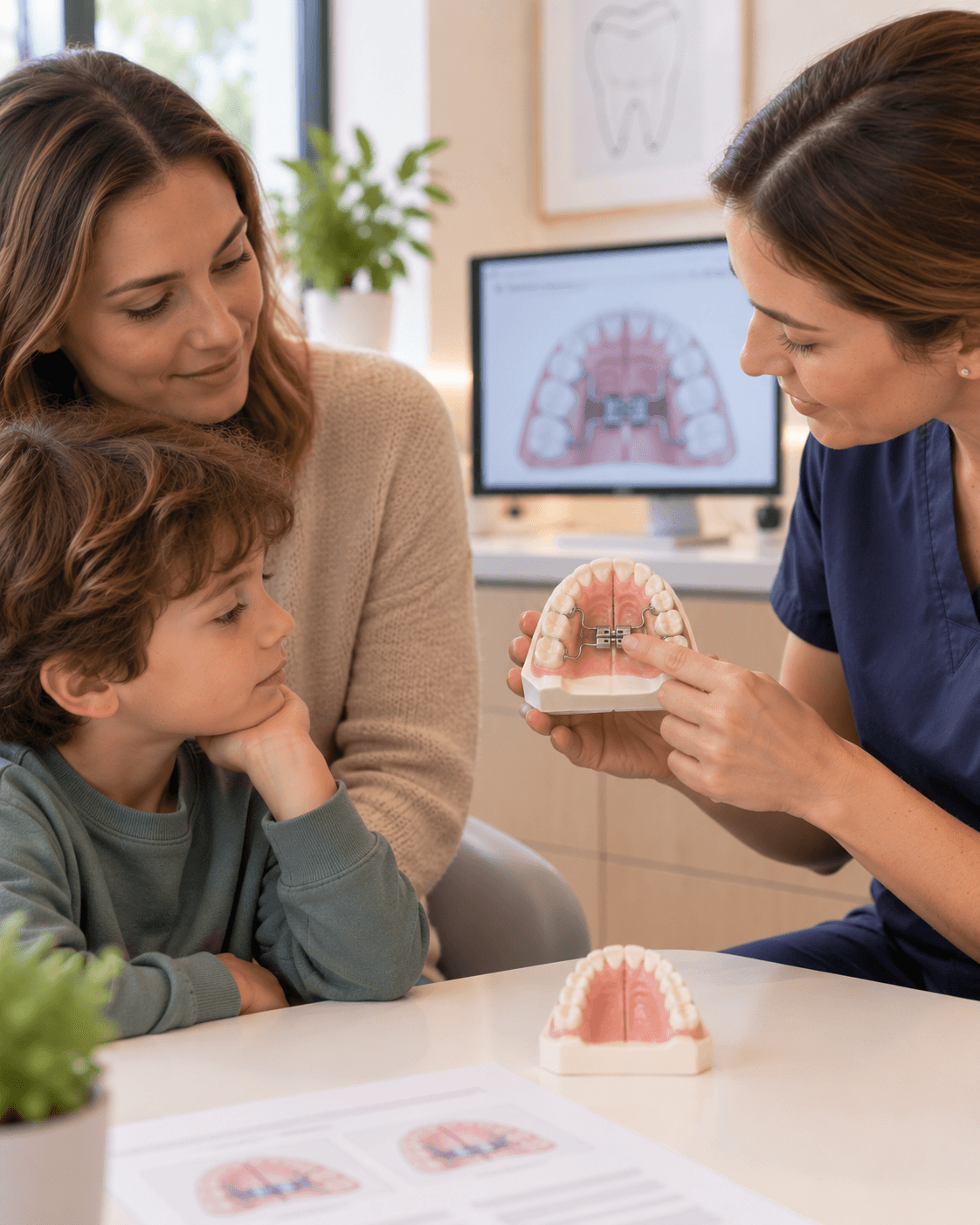
In selected growing patients, interceptive treatment may address a developing crossbite, limited space, an unfavourable jaw relationship, or another problem where timing offers a clear advantage. Expansion is one possible approach; it is not appropriate for every child.
Cristina explains the specific objective, the appliance proposed, how it is used, and whether later comprehensive treatment may still be needed. The aim is to improve the conditions for development—not to treat early without a reason.
- A defined clinical objective before treatment
- Timing linked to growth and dental development
- Parents shown how the appliance and reviews will work
Review
Sometimes the best decision is to wait
When immediate treatment would not add a clear benefit, planned observation avoids unnecessary intervention while keeping development under review. The interval is chosen around tooth eruption, growth, and the feature being monitored.
At each review, Cristina checks what has changed and whether the original plan still makes sense. Families leave knowing which signs to watch for and when the next assessment should take place.
- No appliance unless there is a useful objective
- Reviews timed around expected development
- The plan updated if growth or eruption changes

Frequently asked questions
What patients ask most often.
General answers, to be refined around your diagnosis.
01Does a first visit mean an appliance will be fitted?+
No. The right outcome may simply be monitoring.
02What is maxillary expansion?+
It is an approach used in selected growing patients to address the width of the upper jaw. Indication is individual.
03Is expansion painful?+
Brief pressure or discomfort can occur, especially at the start. Cristina explains what to expect and which signs mean you should call the clinic.
04How do I activate the expansion appliance?+
If home activation is needed, Cristina demonstrates the exact technique and gives you an individual schedule. Never change that schedule without her advice.
The next step
Let’s start by understanding your situation.
A first consultation is time to take stock, answer your questions, and explain the options that may be relevant.